
McDuffie Parole and Probation
Parole and probation can both place a released person under rules in the community, but they start in different ways. The Georgia State Board of Pardons and Paroles decides parole for an eligible state prisoner. Parole is conditional release from the prison portion of a sentence. Probation is imposed by a court, either instead of confinement or as part of a split sentence that combines custody and community supervision. The Georgia Department of Community Supervision, or DCS, supervises felony cases that include parole, reprieve, probation, and split sentences.
A McDuffie County Jail release is not automatically either one. Someone may leave on bond while a case is still open, finish a local term with no supervision, transfer to GDC, or leave after a court orders probation. The court sentence is the root record for probation. For parole, the Board decision and parole record control. These distinctions matter because the McDuffie jail population page reports custody, not the full terms of a sentence after release.
| Point | Parole | Probation |
|---|---|---|
| How it starts | Board-authorized release from a state prison sentence | A sentence or order entered by a court |
| Key public record | Parolee Search, Board decision, or TPM record before release | Sentencing order, docket, and DCS supervision record |
| Local contact | DCS Thomson Field Office after status is confirmed | DCS Thomson for felony supervision; the sentencing court for the order |
| How it ends | Discharge from parole or completion of the term | Court-defined completion, early termination if ordered, or discharge |
- Parole
- Conditional community release during a state prison sentence.
- Probation
- Court-ordered community supervision that may replace or follow confinement.
- Split sentence
- A sentence with a custody portion and a probation portion.
- Discharge
- The formal end of a supervision obligation.
- Absconder
- A supervision status indicating lost contact or failure to report, not proof of a new conviction.
Verify McDuffie Post-Release Supervision
Begin with the last known custody and the type of sentence. A person released from McDuffie County Jail may be on bond rather than supervision. A person leaving GDC may be discharged with no parole, or may enter parole. A felony probation term must be traced to its court order. Use names and dates with care because partial-name searches can return more than one person.
- Check the Georgia Parolee Search by first name, last name, and race. The tool accepts partial search terms, so compare all displayed identifiers before treating a result as a match.
- If the person remains in GDC custody and parole is only being considered, use the TPM information and lookup path. A tentative parole month is not proof that release occurred.
- For felony probation, review the McDuffie County sentencing order and docket. The court record can show a probated or split sentence, its length, later modifications, and violation proceedings.
- After the supervision type is confirmed, contact the DCS Thomson Field Office for local office routing. Do not ask the field office to replace a court record or Board decision.
- If custody may have resumed, check the county jail or GDC custody channel. A parole or probation violation can produce a new booking without erasing the underlying supervision record.
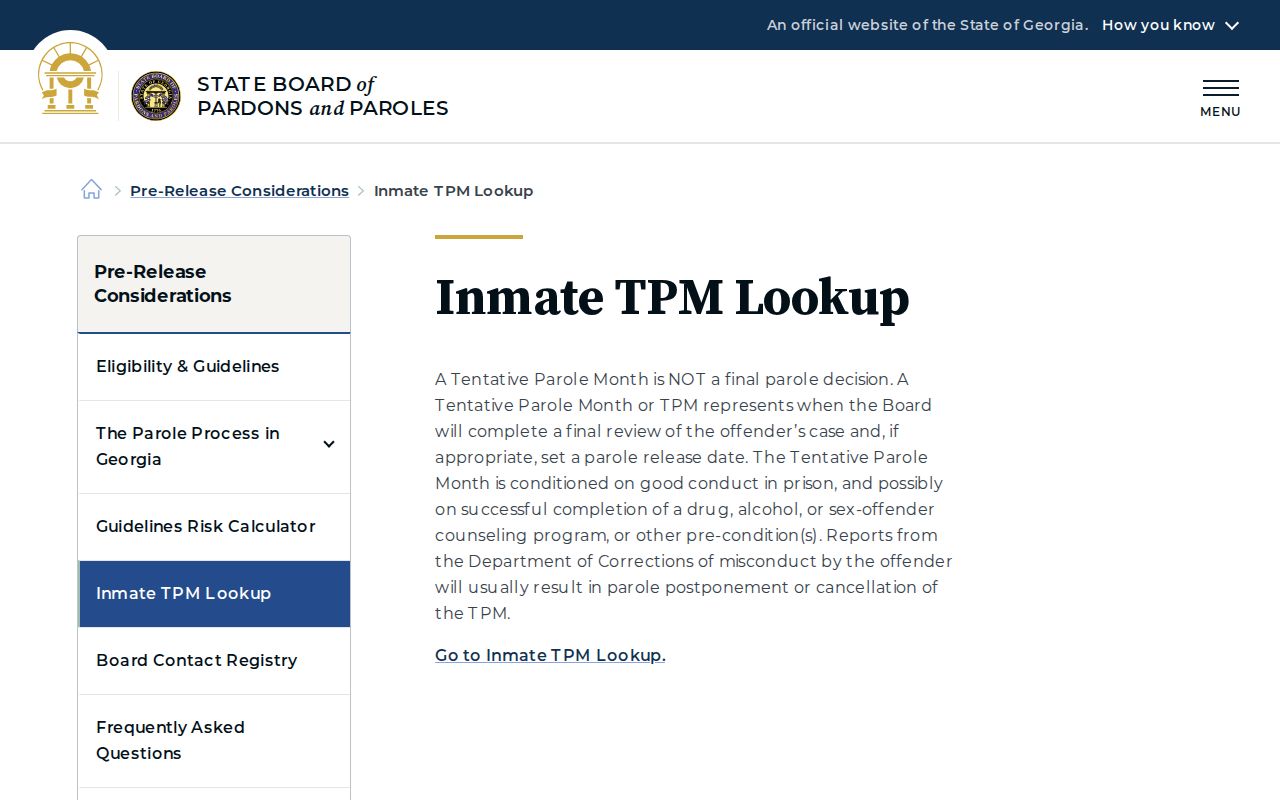
The Board’s public tools serve two different moments. Parolee Search is the closer fit for a person already released on parole. TPM lookup concerns an inmate approaching a possible parole decision. A TPM marks when final review is expected, not an effective release date, and the Board may alter a decision before release.
The official TPM explanation shows how Georgia describes that conditional milestone.
McDuffie Supervision Office in Thomson
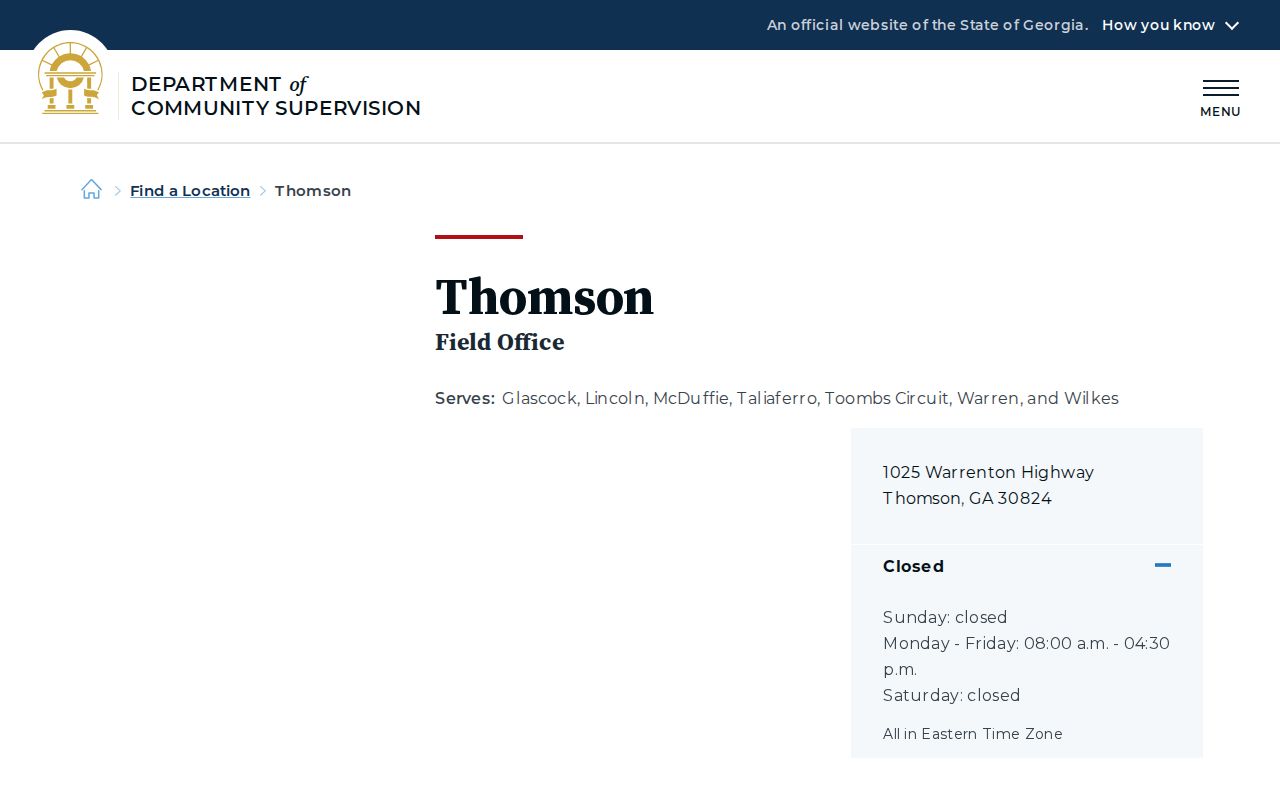
The local supervision route is unusually clear. The DCS Thomson Field Office expressly lists McDuffie among the counties it serves. That makes it the practical field-office contact after a parole or felony probation status has been verified. It also serves several nearby counties, so provide the person’s full name and state identifier if known and state that the question concerns McDuffie County.
DCS Thomson Field Office1025 Warrenton Highway
Thomson, GA 30824
Phone: 706-595-7404
Fax: 706-595-1318
Monday through Friday, 8 a.m. to 4:30 p.m.
The office page names a coordinating chief, but staff assignments can change. Use the office number for current routing. For a disputed probation term, obtain the sentencing order from the court. For a disputed parole status, use the Board record. The field office handles supervision in the community and should not be treated as the source for a county jail release timestamp.
The official Thomson office listing confirms the McDuffie service area and public contact details.
McDuffie Supervision Violations and Warrants
Conditions are the rules attached to parole or probation. They can include reporting, lawful conduct, residence approval, program participation, payments ordered by a court, or limits tailored to the case. The exact terms come from the parole certificate, supervision plan, or court order. A general state description cannot establish one person’s duties.
A violation allegation is not the same as a final revocation. An absconder label generally means supervision staff cannot maintain required contact. A warrant may follow, and a person can be booked at McDuffie County Jail on a parole-violation or probation-violation charge. Check the live custody source if a return to jail is suspected, then check the McDuffie Magistrate Court or Board process for what happened. Release from that later booking may still leave the original supervision term in place.
Georgia VINE can provide custody-change notices where the person and facility participate in its data system, but it does not decide whether supervision continues. Court orders, DCS records, and Board records provide that answer. This separation prevents a custody alert from being mistaken for a supervision discharge.
How McDuffie Supervision Ends
Supervision ends through a formal event, not merely because a name disappears from a search result. Parole can end at discharge or completion of the controlling term. Probation ends under the sentence and later court orders, including any lawful early termination or extension. Obtain the discharge document or court order when the end date must be verified.
The McDuffie Clerk of Superior Court maintains the court path for felony probation orders and later case filings. A jail release record answers when local custody ended, while a discharge record answers when supervision ended. Those dates may be far apart. The broader McDuffie County released inmate search explains how the jail, court, and state records fit together.
Parole eligibility also should not be confused with discharge. Under O.C.G.A. § 42-9-45, general consideration timing is subject to statutory exceptions. Eligibility gives a person a chance to be considered. It does not require parole, set a final release date, or determine when later supervision will end.
McDuffie Parole Decisions and Meetings
The parole decision process is distinct from the Board’s public operations meetings. Georgia’s Board has announced monthly meetings, historically set for the first Tuesday at 10 a.m., but expressly states that individual offender cases are not discussed or considered during those public meetings. Later notices show that a meeting date may move or be canceled. A public meeting calendar is therefore not a hearing calendar for one McDuffie County person.
Individual status is better traced through the Georgia parole process, TPM channel, and Parolee Search. For eligible non-life cases, the Board can deny parole or establish a TPM. Its guidelines consider offense severity and risk factors, yet the Board may accept or reject the guideline recommendation. A majority vote is required for clemency, and a prior decision can change before release.
The possible record sequence is: eligible for consideration, TPM set or parole denied, final review, release date set if approved, release on parole, and eventual discharge. Postponement, cancellation, or rescission can intervene before release. Reading one milestone as the whole outcome creates false certainty.
Parole eligibility under Georgia law is also narrower than a predicted outcome. General felony consideration begins after the statutory time threshold, but serious-offense and recidivist provisions can alter that rule. Aggregate sentences may follow another timing rule as well. Even when a person is eligible, the Board may deny parole or set a later TPM after applying its decision guidelines. Those guidelines weigh offense severity and risk factors, then produce a recommendation the Board may accept or reject. For a McDuffie County inquiry, the statute identifies when review may occur, while the Board record identifies what decision was actually made.
Probation has no matching TPM process. The McDuffie sentencing docket and order establish whether the court imposed a straight probation term or a split sentence. Later filings may show modification, violation, revocation, or completion. That court-centered trail is why a parole lookup cannot stand in for a probation record, even though DCS may supervise both people after release.
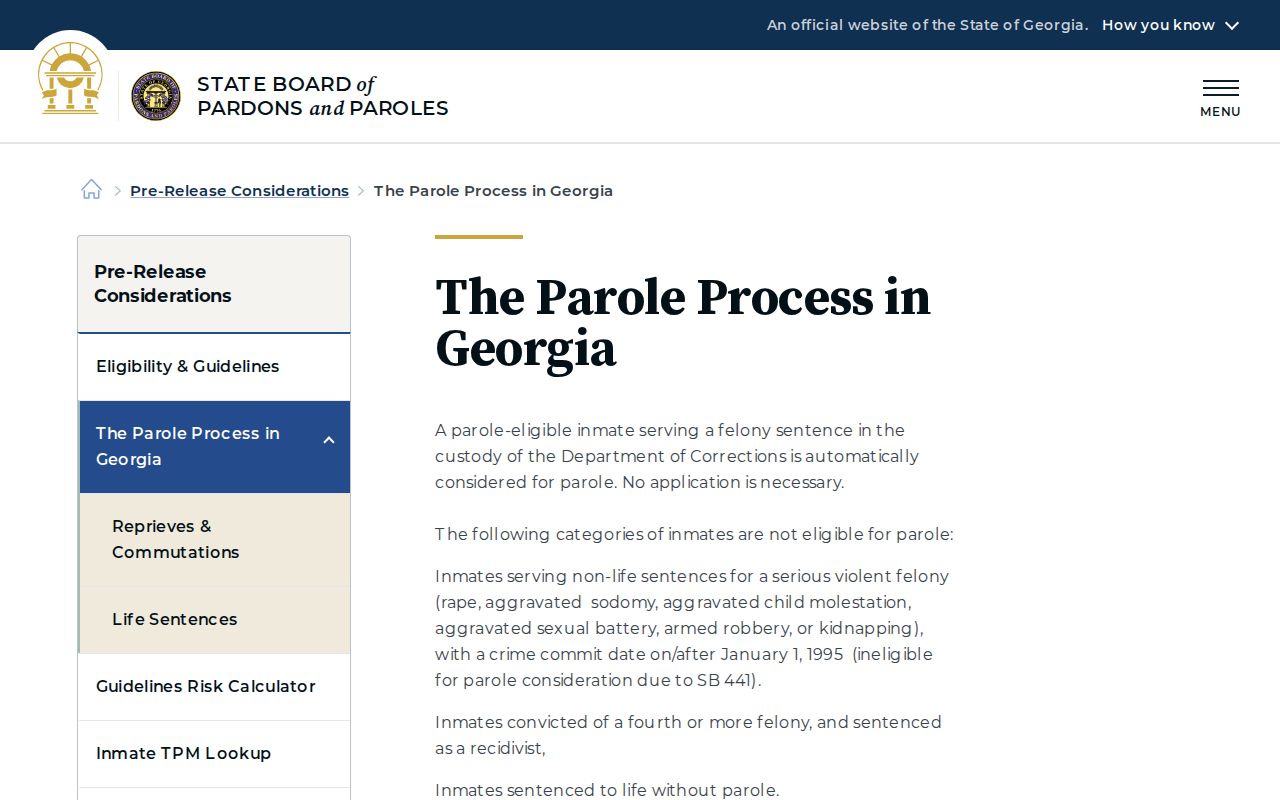
The Board's parole process page illustrates the decision sequence used for Georgia cases.
Note: A public Board meeting is not an individual parole hearing or a promise that a specific case will be decided that day.
Public Record Search
Sponsored Results