
McDuffie County Release Meaning
A McDuffie County jail release means one booking has ended at the McDuffie County Jail, also called the Law Enforcement Center. It does not always mean the person went home or that the case ended. A person may leave on bond, after time served, after a court order, or because another agency accepted custody. A transfer to the Georgia Department of Corrections, another county, the U.S. Marshals Service, or immigration custody is a departure from the local jail but not a community release.
The agency that takes the next action keeps the next record. The Sheriff’s Office controls the local booking and release material. McDuffie courts hold case events and dispositions. GDC records a state prisoner’s status and sentence data. The Georgia State Board of Pardons and Paroles and Department of Community Supervision cover parole and felony probation. BOP and ICE use separate federal systems. Matching the custody type first prevents a false conclusion based only on a missing roster name.
- Discharge
- The end of a custody or sentence status recorded by the responsible agency.
- Time served
- Release after the required confinement time, including lawful credit, has been met.
- Detainer
- A request or hold that can send a person to another agency instead of home.
- Parole
- Conditional community release from a prison sentence under Board authority.
- Probation
- Court-ordered community supervision, sometimes after a split jail or prison term.
McDuffie County Release Types
The public jail pages show custody status and booking facts, but the court or releasing agency supplies the legal basis for the change. A bond release may follow a first appearance or later order. Time served applies when confinement credit satisfies the term. A dismissal may end the charge tied to the booking, while a transfer keeps the person confined elsewhere. Parole applies to a state prison case, not a routine pretrial county booking.
| Outcome | What it means | Best next source |
|---|---|---|
| Bond or court release | Local custody ends under court terms | Jail release record and court case |
| Time served | Required confinement is complete | Jail record and sentencing court |
| State transfer | GDC accepts custody | GDC offender search |
| Federal transfer | USMS or another federal authority accepts custody | USMS case contact, then BOP if sentenced |
| Parole | Prison release continues under supervision | Parole Board and parolee search |
| Probation | Court supervision continues in the community | Court and DCS field office |
A release reason should be confirmed from the record itself. A roster status alone does not explain every hold, condition, or later court event.
McDuffie County Release Record Fields
The McDuffie jail population system connects a person to an arrest record through identity, booking, charge, bond, and court fields. Its short-window and arrest-date views can show an affirmative RELEASED status. They do not publish a complete release-only report, a formal retention period, or a guaranteed release timestamp. For a certified or detailed account, ask the Sheriff’s Records Division for the booking and release material tied to the person and arrest date.
| Field | What it shows |
|---|---|
| Name and physical details | Identifiers used to distinguish similar records |
| Status | CURRENTLY BOOKED or RELEASED on the displayed record |
| Arrest date and agency | When the booking began and which agency made the arrest |
| Days in jail | Elapsed local custody shown by the public view |
| Bond | Displayed bond amount connected to the booking |
| Warrant, count, statute, description | Charge-level identifiers and text |
| Court | The court associated with the listed count |
| Release detail | Formal date, time, reason, or receiving agency when held by the records office |
The online fields are useful leads. They are not a substitute for the originating record when exact timing or transfer authority matters.
Request McDuffie County Release Records
The Sheriff’s open-records channel asks for the requester’s name, phone number, return address, and a specific description of the information sought. Identify the person, approximate arrest date, and the desired booking, release, bond, or transfer field. A narrow request helps the Records Division locate the right event and state whether any part is exempt or restricted.
- Check the public jail views and note the exact displayed name, arrest date, court, and warrant or count information.
- Describe the record precisely, including a request for the release date, release reason, and receiving agency if applicable.
- Send the request through the Sheriff’s open-records page or use the official form.
- Review the office response for cost, redaction, clarification, or availability before requesting copies.
- Use the court or next custody agency when the Sheriff’s record shows a transfer rather than a final community release.
751 Public Safety Drive
Thomson, GA 30824
Phone: 706-597-3862
Fax: 706-597-2682
Records service: Monday through Friday, 8 a.m. to 5 p.m.
Georgia’s Open Records Act, O.C.G.A. § 50-18-70 et seq., governs agency responses. The researched local sources do not state a fixed local copy fee or release-record retention period, so neither should be assumed. Ask for an estimate and the applicable retention rule if those points affect the request.
Restricted McDuffie County Records
Open access has limits. Juvenile records, adoption files, and records sealed by court order are among the exceptions named by the McDuffie County Clerk of Superior Court. Georgia’s O.C.G.A. § 35-3-37 also provides procedures for review, correction, and restriction of qualifying criminal-history material. Restriction is a legal limit on access to qualifying data; it is not proof that no arrest or booking ever occurred.
An old booking can disappear because the public roster window changed, a name was entered another way, or a lawful restriction applies. Court files and law-enforcement data may not change in the same way or at the same time. Ask the agency holding the record to explain its own response. Do not infer a case result from a blank search.
Find McDuffie County Released Inmates
Start with the local source that matches the likely time frame. The 24 Hours Arrests view can show both currently booked and released status for recent bookings. The arrest-date range view supports a wider manual date search. If neither yields an affirmative result, move to the court, Sheriff’s Records Division, or the agency that may have received the person.
- Search the exact name in the current jail roster to test whether local custody continues.
- Open the 24-hour and arrest-date pages. Read the status field, not just the presence or absence of a name.
- Check McDuffie court records for first appearance, bond, disposition, sentence, or warrant events.
- Use GDC only when state custody or a state sentence is plausible.
- Use Georgia VINE for a custody alert or status check where the person and facility participate.
- Use BOP or ICE for the correct federal custody type.
- Request the formal release or transfer record when online sources do not settle the question.
The McDuffie County 24-hour release list instructions explain how to read the mixed booking view. The search does not stop when a name leaves the current roster.
Roster Absence Is Not Release
The local current page is labeled “Currently Booked Inmates.” Its purpose is to show active local bookings, not to preserve a full release archive. Someone missing from that view may have been released, transferred, moved outside the visible date range, or recorded under a different spelling. Searchers should seek an affirmative RELEASED status, a court event, a custody result from the next agency, or a written records response.
The short-window pages solve part of this problem because a recent record can remain visible with the status marked released. Still, the reviewed pages publish no update cadence or retention promise. For an exact timestamp or reason, call the jail information line at 706-595-2040 or contact the Records Division.
The current McDuffie jail roster illustrates the custody-only view.
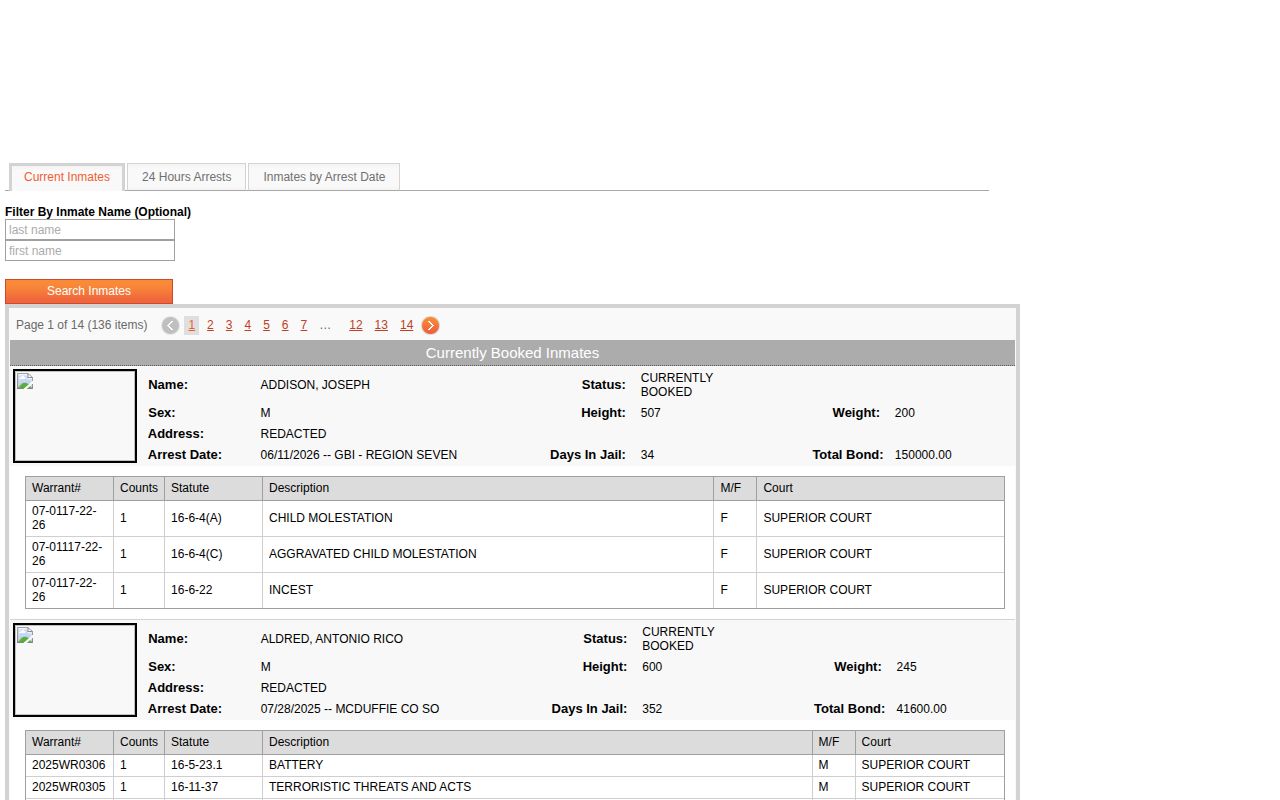
That screen is best used to confirm present local custody, then paired with release and date-range sources.
McDuffie Court Release Clues
The McDuffie Magistrate Court handles warrants, first appearance hearings, county ordinance matters, and disorderly conduct hearings. Those events can help explain a recent move from currently booked to released, especially when bond, a warrant decision, or a first appearance changed custody. The court record is not the jail release log, but it can supply the legal event that the jail status does not explain.
Superior Court and other local courts may hold later disposition and sentence data. The county court directory identifies the proper court, while re:SearchGA may provide participating electronic case access. Court coverage and sealed-record rules still apply. Match the warrant, count, statute, and court fields from the booking view before relying on a case with a similar name.
First appearance is an early court review, not a final case result. A release after that hearing may still carry bond terms, another hold, or a pending charge.
Georgia Offender Release Search
The GDC offender query is for Georgia corrections records. It is not the county jail roster. Use it when the McDuffie release path points to state custody or when the person has a state prison record. Search options include name, GDC ID, case number, and physical description. GDC also advises users to verify public results through its Inmate Records and Information office before treating them as complete.
| Search field | Use |
|---|---|
| First and last name | Broad person search; compare all identifiers |
| GDC ID | Direct state offender identifier |
| Case number | Connects a known corrections case |
| Age or physical details | Narrows similar names |
| Status, facility, release fields | Distinguishes current GDC custody from a state release record |
County bond release and GDC discharge are not interchangeable. A state result may show sentence or release information that never appears in the McDuffie jail view. If a GDC record is unclear, use the GDC open-records portal, which publishes a three-business-day initial response period, nonmedical copies at ten cents per page, and possible search or redaction labor costs.
McDuffie Supervision After Release
A person may leave confinement and remain under parole or probation. The Georgia State Board of Pardons and Paroles makes parole decisions. DCS conducts field supervision for parolees and people on felony probation. The public parolee search can help confirm parole status, while a probation term is best checked against the sentencing court and DCS channel.
The DCS Thomson Field Office serves McDuffie County from 1025 Warrenton Highway in Thomson. It is a local supervision contact after status is established, not a substitute for a jail release record. Parole means conditional release from a prison sentence. Probation is imposed by a court and may begin without a prison release or follow a split sentence.
Use the McDuffie County parole and probation page for the parolee, TPM, court, and local field-office paths.
McDuffie Alerts and Federal Transfers
Georgia VINE provides online, phone, and mobile custody notifications where the person and facility are represented in its data. It is an alert layer. A release notice does not replace the Sheriff’s release record, a GDC discharge record, or the court disposition. For urgent confirmation, contact the agency that held custody.
McDuffie County Jail also has a documented U.S. Marshals Service holding relationship. Under that arrangement, a federal prisoner can leave the jail only to the law-enforcement or Marshal authority specified for the federal custody action. A disappearance from the county roster can therefore mean federal transfer, not release into the community.
If a federal defendant later enters BOP custody, use the BOP inmate locator. BOP explains that RELEASED, or a past release date with no facility, means the person is no longer in BOP custody. ICE’s locator is a current-custody tool and not a county release archive. Each system answers a different custody question.
McDuffie Release Source Comparison
The same name may produce different results because each source covers a different stage. Read the source label and status before drawing a conclusion.
| Source | What it confirms | Key limit |
|---|---|---|
| Current McDuffie roster | Active local booking | Absence does not prove release |
| 24-hour and date-range views | Recent record with displayed status | Not a dedicated release feed |
| Sheriff release record | Formal local release or transfer details | May require a request |
| McDuffie court record | Bond, hearing, disposition, or sentence event | Not the physical custody log |
| GDC offender search | State custody and state release fields | Not every county detainee |
| Georgia VINE | Participating custody status and alerts | Not the full release record |
| BOP or ICE | Relevant federal custody status | Separate coverage and rules |
McDuffie County Release Facility
The facility map identifies one physical detention site in the county. McDuffie County Jail / McDuffie County Law Enforcement Center holds local detainees and has a documented federal-prisoner layer. A local release may go to the community, state custody, another jurisdiction, or federal authority. The facility record and the receiving agency determine which outcome occurred.
No separate state prison, federal prison, ICE detention center, county correctional institution, transitional center, or municipal jail was identified within McDuffie County in the reviewed sources. State, federal, and immigration searches remain relevant because transfers can carry a person beyond the county.
Verify the McDuffie Release Trail
A final verification should preserve the custody sequence. Note the local arrest date, the status wording, and the time each source was checked. Then match the court and agency identifiers. If the jail record says released but a court file shows another hold, ask the Sheriff’s Office which authority controlled the physical departure. If GDC or a federal result begins after the county booking, treat that as a transfer trail until the receiving agency reports its own release.
Names alone are weak matches. Compare middle names or initials, age or physical details, case numbers, warrants, and agency fields when they are public. Aliases and spelling changes can split one person across searches. A blank result can also reflect the wrong custody system. Recheck the county view, state corrections query, VINE, and the proper federal locator based on what the local record says.
For an official account, request the source document. Ask the Sheriff’s Records Division for the local release or transfer event, the clerk for the court disposition, GDC for state corrections material, or BOP for the federal record it controls. Each response should be read within its scope. Together, those records can show whether local custody ended, where the person went, and whether supervision or another form of custody followed.